Thursday, 3 June 2021

Reference List of Video Podcast.

REFERENCES LIST:


Be Kind Rewind, 2020. How Ingrid Bergman Became Hollywood's Exile. [online] YouTube.com. Available at: <https://youtu.be/m1ZZXW9fkLQ> [Accessed 24 May 2021].


Gorman, R. F. (2008) Great Lives From History. Pasadena, Calif: Salem Press (Great Lives From History). Available at: http://search.ebscohost.com.proxy.library.dmu.ac.uk/login.aspx?direct=true&AuthType=ip,shib&db=e000xww&AN=253533&site=ehost-live (Accessed: 24 May 2021).


Jeffrey Fleishman, 2017. 'Guess Who's Coming to Dinner' is 50 and racial tension still a problem in America. [online] latimes.com. Available at: <https://www.latimes.com/entertainment/movies/la-ca-guess-dinner-anniversary-20170131-story.html> [Accessed 22 April 2021].


Biography.com Editors, 2014. Katharine Hepburn - Biography. [online] Biography.com. Available at: <https://www.biography.com/actor/katharine-hepburn> [Accessed 1 May 2021].


Sanghani, R., 2017. Still a feminist icon. [online] The Telegraph. Available at: <https://www.telegraph.co.uk/films/classic-british/katharine-hepburn-feminist-icon/> [Accessed 1 May 2021].


Bianco, M., 2016. The Most Daring Thing About Katharine Hepburn? Her Pants. [online] Vanity Fair. Available at: <https://www.vanityfair.com/hollywood/2016/05/katharine-hepburn-style-pants> [Accessed 1 May 2021].


Cawley, C., 2017. How to Make Your First Movie With Shotcut. [online] MUO (Make Use Of). Available at: <https://www.makeuseof.com/tag/make-first-movie-shotcut/> [Accessed 24 May 2021].


Oscars, 2011. Katharine Hepburn and Barbra Streisand Tie for Best Actress: 1969 Oscars. [online] YouTube. Available at: <https://youtu.be/PoNdQxkI-0w> [Accessed 1 June 2021].


Flanagan, 2020. Katharine Hepburn interview with Barbara Walters 1991. [online] YouTube. Available at: <https://youtu.be/40Dy8PRgNm0> [Accessed 1 June 2021].


CBS, 2009. Katharine Hepburn Interview with Morley Safer (1979). [online] YouTube. Available at: <https://youtu.be/v_iooSis7bk> [Accessed 1 June 2021].


CBS, 2017. 60 Minutes - Katharine Hepburn (1987). [online] YouTube. Available at: <https://youtu.be/MihHDqVOrnI> [Accessed 1 June 2021].


The Dick Cavett Show, 2018. Katharine Hepburn's First Day in the Theatre. [online] YouTube. Available at: <https://youtu.be/LI0Tf-AeQ3A> [Accessed 1 June 2021].


RKO, 2016. Hollywood the Golden Years: the RKO Story. [online] YouTube. Available at: <https://youtu.be/3Obk8ZNPh8E> [Accessed 1 June 2021].


Awstriae, 2015. Morning Glory (1933) - Katharine Hepburn. [online] YouTube. Available at: <https://youtu.be/mYOGfNdwuC0> [Accessed 2 June 2021].


Video Biker, 2020. Sylvia Scarlett - "Rolling Stone". [online] YouTube. Available at: <https://youtu.be/y8t7a8wwWhM> [Accessed 2 June 2021].


MovieClips, 2017. Adam's Rib (1949) - Equality Scene. [online] YouTube. Available at: <https://youtu.be/hdQOL2aFufE> [Accessed 2 June 2021].


LittleWaspAnt, 2011. Scene from The African Queen. [online] YouTube. Available at: <https://youtu.be/V7_vnpQUZkE> [Accessed 2 June 2021].


MovieClips, 2012. Guess Who's Coming to Dinner - Two People Who Fell In Love. [online] YouTube. Available at: <https://youtu.be/2wTJfcaezu0> [Accessed 2 June 2021].


ACPicks, 2019. The Lion in Winter (1968) – And I am cruel?!. [online] YouTube. Available at: <https://youtu.be/vsWUGoFKTtA> [Accessed 2 June 2021].


BIBLIOGRAPHY:


Henderson, A., 2015. How Katharine Hepburn Became a Fashion Icon. [online] Smithsonian Magazine. Available at: <https://www.smithsonianmag.com/smithsonian-institution/how-katharine-hepburn-became-fashion-icon-180955228/> [Accessed 25 May 2021].


LA Times, 2003. Katharine Hepburn, a legendary legacy. [online] Daily Pilot. Available at: <https://www.latimes.com/socal/daily-pilot/news/tn-dpt-xpm-2003-07-04-export22260-story.html> [Accessed 25 May 2021].


D'Andrea, D., 2015. Katharine Hepburn paved the way for women in Hollywood – SheKnows. [online] Sheknows.com. Available at: <https://www.sheknows.com/entertainment/articles/1098957/katharine-hepburn-feminist/> [Accessed 25 May 2021].


Tuesday, 1 June 2021

Video Podcast: Developing a Script.

*the script does not include the mention of visuals (clips form the films, interviews) that will be included in actual video podcast*

 THE SCRIPT


INTRODUCTION

Katharine Hepburn is one the most accomplished actors of all time. Till this day no one has ever won more Academy Awards for acting than Miss Hepburn did; she won them 4 times; all of them for a lead role. While Katharine remains a very popular figure among actors, film directors and film lovers; her legacy seems neglected by a young generation. If you'd say to an average teenager or young adult just simple 'Hepburn' it is likely that they will think immediately about 'Audrey'; while Audrey Hepburn is icon on her own; a sex symbol of her times next to Marilyn Monroe; Katharine is the one who is very often described as one of the greatest actors of all time. This episode of Divas of Golden Age of Hollywood will aim to bring awareness; especially to a young audience about the legacy of Katharine Hepburn; her early life; the importance of the roles that she has taken; and how those affected the society; sometimes causing lots of controversy.

EARLY LIFE OF KATHARINE HEPBURN

To begin with; let's focus on early life of Katharine and how she got into acting. Katharine Hepburn was born into a very liberal couple; her father was a urologist who sought to educate the public about the prevention of sexually transmitted diseases; her mother was a suffrage activist; so since the very beginning she was being taught about sex equality. (Biography.com Editors, 2014). After graduating from Bryn Mawr College in 1928, she began her career in earnest. Under the name of Katharine Burns, she made her Broadway debut in Night Hostess the following year. The Warrior's Husband (1932), a comedy set in the land of the Amazons, was Hepburn's first significant Broadway triumph. RKO Radio Pictures invited her to Hollywood shortly after that. she had a strong film debut in George Cukor's A Bill of Divorcement (1932), a drama co-starring John Barrymore. Hepburn was next cast in Dorothy Arzner's Christopher Strong as an aviator (1933). With just her third film ever Morning Glory (1933) she won her first Oscar. In the document called  'Hollywood the Golden Years: the RKO Story' Hepburn describes how badly she wanted to get that role.

LATE CAREER

Since Morning Glory; Katharine was already predicted to become one of the greatest stars of Hollywood. Since her name was already established in the industry; Katharine could take the parts that she really felt as an artist that speaks for her and she wasn't afraid of taking risky roles. The first controversial role that she has taken was Sylvia Scarlett (1935); in the film she plays a titled Sylvia who have to become Sylvester; to protect her father; which decided to run away from France to England; because of his gambling problems. With this role Katharine broke gender norms; in 30s she played a man; at the time this role could be very damaging for her image; yet Katharine was not afraid of the challenges, so she took the role anyway. Also the film contains a scene of Katharine kissing another actress; which is one of the first lesbian kiss showed in films.

SYLVIA SCARLETT [GENDER NORMS]

From Sylvia Scarlett there were many other roles that were considered risky or even controversial; one of them was Adam's Rib (1949); in which she played the character of a strong woman, a lawyer, who fights for the woman rights and fairness. Katharine Hepburn with that role payed homage to all the ambitious women; who tried to be taken seriously by the society. She played a role of a lawyer who believed in equality and at the very end of it she won her case; letting everybody know that she has the guts to fight against anyone; even against a man of same profession.

THE AFRICAN QUEEN

3 years later; Katharine took a role of Rose Sayer in African Queen (1951) starring with Humphrey Bogart. Rose at first seemed like very weak person; who was dependable on her brother; she was a sister of missionary and after brother's death; She is trying to escape the Africa with the help of a drunk sailor; Charlie Allnut; the couple falls in love with each other; and both of them have positive impact to one another. Rose became very brave; fearless in fact; and Mr Allnut decided to quit drinking alcohol; Throughout the film Rose is proving that she is a strong character; she repairs the engine of their boat; and seems less afraid of restless water that the Sailor himself. Till this day; people jokingly call Rose Sayer a female version of Rambo.

GUESS WHO'S COMING TO DINNER

30 years after Katharine won her first Oscar for Morning Glory; she has won her second one for Guess Who's Coming to Dinner (1967). It was probably the most controversial film of Katharine's; because it told the story of interracial couple as a true product of love; and something that is true and should be treasured. At the time of its release in many states of America interracial couples were still illegal. Shortly after film hit the movie theaters, actually a part of them; because many movie theaters banned the production and refused to display it; film cast started to receive death threats. The film had enormous impact on the cinema; it was a risky production; but it definitely opened doors for actors of colour to be taken more seriously in a profession.

THE LION IN WINTER

Her third Oscar was given to her for her role of Eleanor of Aquitaine in Lion in Winter (1968). The chemistry of love and hatred between Katharine Hepburn and Peter O'Toole was simply amazing. The character of Eleanor was at the same time strong and weak; she wasn't afraid to show her weakness; but maybe this made her even stronger as a character. Katharine's third Oscar till this day remains legendary or some might say iconic; because that year the Oscar for Best Actress actually went to both Katharine Hepburn and Barbara Streisand; it was the second ever acting tie in Academy history; and the first in Best Actress category.

ON GOLDEN POND

The forth Oscar that Katharine has won; was for her role of Ethel in  On Golden Pond; co-starring with Henry Fonda. The film tells the story of an elderly couple who loves each other deeply. Only few films in Academy history managed to win Oscar for both Best Actress and Best Actor in a one film and On Golden Pond did just that.

WHY KATHARINE WAS NOT ATTENDING OSCARS

Despite winning 4 Oscars; Katharine never attended the ceremony to actually receive it; In the late 80s and early 90s Hepburn finally started to give interviews about her life and her achievements. In the interview with Morley Safer; Katharine opens up about not attending Oscars; she says that the reason behind it; was that she afraid that she won't win.

LATE INTERVIEWS

She also didn't think that acting is a higher art; in her interview with Barbara Walters she said that painting can be considered high art but not acting 2

She didn't hold back when she was asked about very gentle and controversial topic like Euthanasia; she was in a favor of it and she clearly stated that.

Katharine Hepburn is truly one of the kind; and her legacy will never be forgotten.


Wednesday, 26 May 2021

Creating my sign off project; final steps.

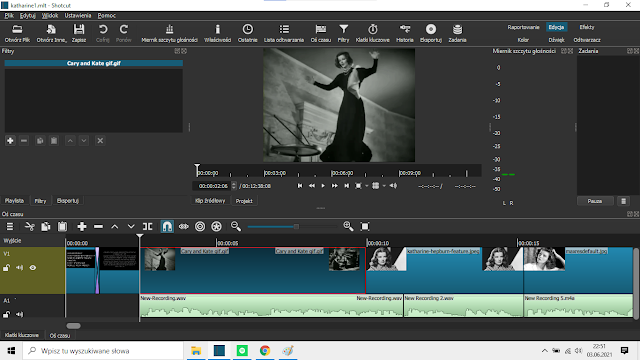
 In today's post I am going to describe the final process of creating my sign-off project; which was putting all the research that I have carried into one piece; final product; a video podcast.

The first thing that I have done was to create a image with my details at the beginning of my video podcast; I have added there my name; my student number; module; my tutor; title of the podcast.


Then I have added pictures, gifs and any other visuals that I would be using; I was very satisfied with the fact that Shotcut allowed me to actually use gifs in my project; there are many other video editing softwares who is not allowing on such thing; using gifs made my work way much interesting and enjoyable.


After that I decided to add all the movie clips and interviews of Katharine Hepburn into the project. After cutting them in many pieces I decided to reference them properly; to do so I used option ''ad subtitles''; after using that option I was able to put information on videos about their original origins.


Next step was to put the audio into the podcast; which is the crucial element; I have succeed with doing so; I was able very easy to transfer my audio clips onto the project; then I had to adjust them and cut them in many pieces; I was cautious with it; I wanted to avoid my audio going at the same time with the audio of the interviews; it took some time; but at the end every section was kept separate and in place.


The last step was to put the reference list at the end of video podcast; I did that on separate images; because showing them on one image would be unreadable for the audience; that's why I have decided to put them on 4 different images.


That is how my working process looked like using Shotcut; I really had fun; but at the same time I have put lots of work to make this all work together; and I am satisfied with the final outcome; I would like to create another video podcast pretty soon.,


Tuesday, 25 May 2021

User Experience

In today's post I am going to review the WIX site of my friend; Klaudia.

The first thing that I have noticed after clicking on site's link was the main page. I could see her name and also the occupation that Klaudia probably has her course related to. It is clear; I know what she is doing and I know the main theme behind the page.

Scrolling down I could spot ''About Me'' section. It had really great picture attached to it; great quality and professional. Though I must say the description itself will need some improvement. There a just a few grammar mistakes; but after correcting them; the section would be in a very good shape. 

Moving on I found myself in a 'Gallery' section. The section is very clear; sub-links are working correctly; I click on a title it takes me immediately to the actual work.

The 'Contact' section presents itself very good; it's clear and all the information provided are visible.

Overall the site is in a good condition; I did not bother to find any information that I wanted to check; like I have stated before the only thing that requires correction would be 'About Me' section; which needs only a few mistakes checked.

Monday, 24 May 2021

Research on video podcasts.

To begin my research; before even making one about Hepburn; I have decided to explore the primary field of my project; which is video podcast. I have never done one before so I felt the need to research in depth and learn about; how video podcast are being made. A useful example of video podcasts are being made by the YouTube channel called ‘Be Kind Rewind’; the woman of this channel remains anonymous; so she posts videos under that nickname. The video that helped me understand how the video podcast should be made was titled ‘How Ingrid Bergman Became Hollywood's Exile’ (Be Kind Rewind, 2020). 

In a video about Ingrid Bergman the author first explained; who Ingrid Bergman was; her childhood, first step in acting career and how she had developed to be known as one of the greatest female actors back then. It really made me realize that before even telling my audience about Katharine’s achievements; first; I should present to them her history; how she became influential in the first place; by skipping such information; I could possibly make my audience confused; because not everyone is familiar with her and her work. So the introduction to KH is truly essential to understand the aim of my project; which are her achievements. 

Nextly while watching that video podcast; I found out that the author put lots of work into visuals; they were carefully picked by the author and put well together into one piece. While she was speaking the clips of the films starring Ingrid Bergman were shown in the background; it made that podcast very interesting; not only the viewer was focusing on the information being said by the author; but also on visuals; that kept the audience entertained and interested; visuals makes the audience enjoy your work more. 

Visual background was not the only thing included in that video podcast; other than that; she used fragments from interview as a part of her ‘script’; instead of quoting the actor; she used her own words by showing the audience fragment of her interview; I thought that it was very interesting way of showing the audience the person she was talking about; it created sort of a friendly bound between the viewers and actor; they were able to hear her voice instead of classical quotation; I would use the same technique in my own video podcast.


REFRENCES:

Be Kind Rewind, 2020. How Ingrid Bergman Became Hollywood's Exile. [online] YouTube. Available at: <https://youtu.be/m1ZZXW9fkLQ> [Accessed 24 May 2021].


Tuesday, 18 May 2021

Software testing; SHOTCUT.

 In today's post I am going to test the free editing software; Shotcut. 


Shotcut is a free, open-source, cross-platform video editing software that you can use on Windows, macOS and Linux. Its main advantages are many different video formats support and the fact that it doesn’t require import, which means that it provides native timeline video editing.

I didn't have any problems testing that software; it was very clear and I knew exactly what to do; there were many editing options; filters; that are not complicated.

You can add many layers to your project; sound and image; that would be very useful when it comes to my sign-off project; because I will be doing video podcast; so knowing that I would be able to work both on my audio and image is really helpful.

I have also found great video on YouTube explaining how to use Shotcut; the tutorial was clear and I got very useful information from watching it.


REFERENCES:

Bai, 2020. Shotcut Video Editor - Tutorial for Beginners in 10 MINUTES!. [online] YouTube. Available at: <https://youtu.be/P9pzmzXj03A> [Accessed 18 May 2021]. 

Monday, 3 May 2021

Adam's Rib (1949)

 As a part of my final project research I have watched a romantic-comedy film 'Adam's Rib' (1949) directed by George Cukor starring Katharine Hepburn and Spencer Tracy. The film tells the story of married couple who come to oppose each other in court.


After Doris Attinger is charged with the attempted murder of her philandering husband Warren, happily married attorneys Adam and Amanda Bonner find themselves on opposing sides of the courtroom. It's a simple case for Adam; the facts aren't in question; Doris shot her husband after she found him with his girlfriend. Amanda, on the other hand, takes a different approach; she believes that women are handled differently in the courts than men and that Doris should be released. They try to maintain their legal squabbles in the courts and not at home, but it inevitably leads to a tumultuous family situation. (Gary, n.d).

The character of Amanda Bonner (Katharine Hepburn) is really interesting; she is refusing to be passive when it comes to the topic of sex equality; she believes that women are treated enormously unfair. There is one specific scene that is way ahead its times; the scene of the final speech made by Amanda before the final verdict. Amanda tells that judges should apply the same law to Doris just like they will apply if she was a man; she told them to picture her as a man that tries to save his marriage; Doris; a woman; is in that position; once again she begs them to judge her fairly. 


The film shows a strong woman, a lawyer, who fights for the woman rights and fairness. Katharine Hepburn with that role payed homage to all the ambitious women; who tried to be taken seriously by the society. She played a role of a lawyer who believed in equality and at the very end of it she won her case; letting everybody know that she has the guts to fight against her husband working in a same profession as she is. 


REFERENCES: 

Gary, K., n.d. Adam's Rib (1949) Plot Summary. [online] IMDb. Available at: <https://www.imdb.com/title/tt0041090/plotsummary> [Accessed 3 May 2021].

Hazelton, J., n.d. ADAM'S RIB Movie Poster (1949). [online] Filmposters.com. Available at: <https://www.filmposters.com/pd/ADAM-S-RIB-Adams-Rib--Movie-Poster-1949/20708> [Accessed 3 May 2021].

Movieclips, 2017. Adam's Rib (1949) - Equality Scene (7/10). [online] YouTube. Available at: <https://youtu.be/hdQOL2aFufE> [Accessed 3 May 2021].
 

Monday, 26 April 2021

Action Plan

In today's post I am going to display my action plan for my video review about Katharine Hepburn and her legacy,


ACTION PLAN

1. Doing research on video podcast; finding the creator of those and writing about key points taken from the video.

2. Doing research on Katharine Hepburn and writing post about it.

3. Doing research on one of the films starring KH and analyzing it (Adam's Rib).

4. Doing research on software; that would be used while creating video podcast.

5. Doing research on interviews that Katharine Hepburn appeared on.

6. Writing a script for the video podcast and posting it on blog

7. Creating video podcast using chosen software

8. Displaying the progress of creating video podcast using software; attaching screenshots of the process and its results.

Thursday, 22 April 2021

SMART OBJECTIVE: Idea for my major project.

 The topic that I have chosen as the theme of my final project is 'Katharine Hepburn; an icon ahead of her times'.

(Katharine Hepburn Banner)

I am going to make a podcast;  I have never done a podcast and I am a person who prefers to speak rather than write; I feel like my words when spoken are taken more seriously so I think it would be exciting to do a podcast. The work of mine will focus on the legacy of legendary Katharine Hepburn; the roles that she played; the importance of those and the impact that these parts had on the cinema. Since the beginning of her career she refused to present stereotypical beauty standard; wearing pants became her signature; in those time she was one of the first woman, public figures to wear pants; by doing so she broke gender norms; that were telling; 'women wear skirts, men wear pants'. 

Other than roles that were representing strong female characters fighting with stereotypes she also took a part in the film, that changed situation of black actors in the Hollywood ever since; Guess Who's Coming to Dinner (1967). The first big box office film that showed interracial couple as loving and beautiful relationship. After its release the film cast started to receive death threats. (Fleishman, 2017).

It is just a sneak peak of her large legacy; the final podcast will include way much more detailed information.


REFERENCES:

Fanpop, I., 2020. Katharine Hepburn - Banner. [online] Fr.fanpop.com. Available at: <https://fr.fanpop.com/clubs/katharine-hepburn/images/38254435/title/katharine-hepburn-banner-fanart> [Accessed 22 April 2021].

Jeffrey Fleishman, 2017. 'Guess Who's Coming to Dinner' is 50 and racial tension still a problem in America. [online] latimes.com. Available at: <https://www.latimes.com/entertainment/movies/la-ca-guess-dinner-anniversary-20170131-story.html> [Accessed 22 April 2021].

Wednesday, 21 April 2021

Piktochart board

Recently we were asked to present our '3 amazing project ideas' as a iconography using Piktochart; here are the results:


Tuesday, 20 April 2021

Three Amazing Ideas

In today's post I am going to describe three ideas that I would consider when it comes to creating my final project for the Media II module. 

The 1st and the most interesting idea that I would like to develop would be an essay (with a possibility of making podcast out of it) about Katharine Hepburn and her influence on the cinema world; symbol of feminism (Little Woman 1933, Woman of the Year 1942, Adam's Rib 1949, African Queen 1951). She also took a role in a film that has changed the way African-American people were shown in films ever since; Guess Who's Coming to Dinner 1967; it was one of the first films that has showed interracial couple as a good, loving couple (at the moment of its release in many states of America interracial couples were still illegal) 


The 2nd idea would be about writing a script for a short film; since currently I am writing a script for Film and TV Studies module about depression/isolation/rejection this one would be more cheerful; I am thinking about writing about the importance of our environment and how pollution could destroy it .

(unsplash.com - the internet source of free-usable images) 

The third idea would focus on supernatural themes used in films. The essay will describe the very first movies related to that topic and also explain why so many people love films that have paranormal themes attached to it. I will later on describe one of the most known thriller/horror films from The Golden Age of Hollywood; Gaslight (1944) and some recent supernatural related films like Hereditary (2018). 


REFERENCES:
Oxenreider, n.d. Katharine Hepburn Wearing Pants. [image] Available at: <https://theartofsimple.net/styletruths/katherine-hepburn-pants/> [Accessed 20 April 2021].

Gasquez, 2015. Gaslight de George Cukor, quand la colère incandescente devient émancipatrice (1944). [image] Available at: <https://www.deuxiemepage.fr/2020/06/15/gaslight-george-cukor-1944-ingrid-bergman-colere/> [Accessed 20 April 2021].

Tuesday, 13 April 2021

Icebreaker challange.

 During today’s class we were asked to draw a machine that relates to us in some way; the machine that I have chosen was a video camera.


Video Camera is a symbol of my interest;  the cinema world. I might even suggest that video camera is a allegory of it; it is the machine that started it all; it allowed artists to capture their vision through it.


Welcome to the 3rd term!

Times flies so fast; it feels like I just have started my journey at DMU last month; even though it began almost seven months ago. Throughout these past terms I have learnt a lot. The 2nd term was definitely my favourite; since we; as a students; were given new modules I was really thrilled to participate in a Film & TV Studies; since Film Studies would be my main course that I will hopefully graduate from this University. 

When 2nd term came to its end and I had lots of free time I have decided to watch a few of the films that were on my ''watch list''.  Productions that I have watched were magnificent; well written and put out together.

One of them was Autumn Sonata (1978) directed by Ingmar Bergman; starring legendary Ingrid Bergman (Don't be fooled by their surnames; they were not related witch each other) 


Autumn Sonata tells the story of  a world famous pianist; Charlotte; who decides to visit her daughter; Eva; after couple months of absence in her daughter's life; little did Charlotte know that Eva decided to take her younger, disabled sister from Nursing Home; to which her mother checked her in. Charlotte has to face her disabled child; Helena; once again in her life. (Thuresson, 2020)

The film itself is very  theatrical; it mostly bases on dialogues; the script is perfectly written. The characters have many layers; they are not plain. The character of Eva is the most complex one; she is hiding her emotions; and through the whole life she held  grudge against her mother; which did not know about any of these; she thought she gave Eva a great childhood; which in reality was very toxic and damaging for little Eva; she developed lots of insecurities. 

The camera work also a great part of that production. Lots of close-up shots helped the viewers feel emotions of the characters; without even hearing a word from them.

The colours were rather grayish; which increased the dark atmosphere in the film. The perfect contrast to the whole scenery was achieved by Charlotte's dress; which was covered in a bright red colour. 

REFERENCES:

\Target, 2021. Autumn Sonata (DVD). [online] Target.com. Available at: <https://www.target.com/p/autumn-sonata-dvd/-/A-14654991> [Accessed 18 April 2021].

Thuresson, 2020. Autumn Sonata (1978). [online] IMDb. Available at: <https://www.imdb.com/title/tt0077711/plotsummary?ref_=tt_stry_pl> [Accessed 18 April 2021].

Tuesday, 16 March 2021

Sign Off Project - Reflection / Comparing with 1st term work

Today I am going to describe my thoughts about my video review about the film Who's Afraid of Virginia Woolf (1966)


Looking back at my first review I feel kind of embarrassed for it. The First term was not that long time ago; yet I can say that I am proud of the work that I have put in the second term. My last video review was about 70% talking about the plot and only 30% about its values. This term while creating video review script I've spoken very briefly when it comes to the plot. I focused more on technical values (camera angles, dialogues, lighting, music, sound); values about I didn't know last term. 

I have noticed that this time I was looking into the camera and not somewhere else. I think that by doing so I showed more respect towards my audience. The way I talked wasn't too generic; which I can't say about my first video review when it was kind of robotic. 

The duration of the video review changed as well, last term; I didn't know what else should I say in my review; this term; I was worried that I am not able to say everything that I know about the picture; there so many technical things that I would like to display but I really didn't want to go over 10 minutes of the review; and the end I didn't, so I was very pleased with it. 

It is probably the last time I am doing a video review during my international year; if there will be any sing off project due to third term I think that these video reviews taught me enough about film that I would be ready to create something small on my own; perhaps a short video with not so complicated script.

I cannot wait for another term; the second term taught me even more than the first one; I am truly excited about how my future at DMU will look like in a couple of weeks,

see you third term! (Hopefully)


Sunday, 14 March 2021

CREATING MY VIDEO REVIEW

 In today's post I am going to describe the process of creating my video review of the film Who's Afraid of Virginia Woolf (1966) for my sign off project.


Picture 1: Elizabeth Taylor as Martha (Lattanzio, 2020)

The first step that I have decided to do; was to record myself. To do so I used my IPhone 7 camera; I was very happy with the results that I have achieved; the quality was satisfying. I took about 50 of videos and then I cut them into the smaller pieces. Thankfully my mother let me used her Atelier for the recording time.


After recording myself I have decided to open up my editing software;  Shotcut; shotcut is a free editing software that allows you to do multiple things related to editing;  it is a shame I worked on Windows Movie Maker last term; the free version of it did not allow me to do much with my project. Shotcut on the other hand allowed me do everything that I wanted. First I pasted my recordings there and then I cut them precisely 


Then I decided to paste video clips from Who's Afraid of Virginia Woolf and then adding the tittle to each clip with the information about the director and also a year of release. Shotcut did not have any difficulties with such operation; everything went smooth and I was satisfied with the results. 


After pasting my recordings and video clips from the picture; I have used a filter that allowed me to make a very smooth transition between video clips and my recordings; it made it look way much more professional and I was very pleased with the outcome.


The last step of creating my video review was to include my reference list. I have created reference credits and pasted this at the end of my review. The font is clear and readable. The background colour is black and the font is white. 


 The last step was to convert the project into the video file; to do so I have chosen to convert it into MP4 format. I was thrilled with the results; because the quality was amazing but the size of the video review turned out to be only 200mb; for that quality I was really pleased. 


Friday, 12 March 2021

Who's Afraid of Virginia Woolf Video Review - Script

In today's post I am going to display the script of my video review that I have been working on for past weeks, enjoy. 

 T H E  S C R I P T


[INTRODUCTION WITH A HOOK]

Who's Afraid of Virginia Woolf (1966) is one of the greatest films defying cinema during the 60s era. It is one of those films that have stood the test of time and till this very day remains with its iconic status. New York State Writers Institute described the picture as a 'one of the most remarkable adaptations of a stage work in American film history'. But what exactly made us fall in love with this film? Hopefully at the end of my review; there will not be such doubt.

[PLOT LINE]

Who's afraid of Virginia Woolf is a drama film directed by Mike Nichols; it tells the story of a middle aged married couple Martha (played by a Dame Elizabeth Taylor) and George (Richard Burton). The couple tends to fight witch each other quite frankly; both of them does not mince their words. The fact that Martha's father is the University President and George happens to be teaching history there is not making things any better. Eventually Martha tells his husband that she invited guests over their house; a young biology professor; Nick (George Segal) and his wife; Honey (Sandy Dennis); as the evening goes by and more alcohol is being consumed the tension between middle aged couple increases; Nick and Honey are caught up in their game; at some point the guests become aware of the meaning of that game; they decide to leave the house leaving broken lovers alone to each other. (Huggo, n.d)


[DIALOGUES]

What really amazing about this movie is; are dialogues. A truly masterpiece when it comes to the script. The film is based on the play with the same title written by Edward Albee in 1962.  As simple as the picture might appear it does include one of the best dialogues in the film history. The scenes between Elizabeth Taylor and George Burton are really amazing; even within the first minutes of the film the viewer can appreciate the well written dialogues; the scene in the kitchen; while Martha is trying to remember a film starring Bette Davis and says iconic ''What a dump'' proves this point.


[CAMERA WORK]

The camera work was astonishing as well. In the scene when Martha is complaining about George being not accomplished enough to take over the President Office after her father she walks through the room with camera following her; it is called a tracking shot; it definitely made the audience feel the anger that their living room was filled with. The viewers' eyes were following her just like the camera that captured that movement of hers.

Another example of a wonderful shot was captured in the scene when George decided to trick her wife with a fake gun that instead of a bullet was loaded with a hidden umbrella in it; before pulling the trigger; the director focused entire attention on Taylor's face; to maximize the fear om her face he used extreme close up shot to do so; the effect of using that specific shot was very spectacular.


[THE LIGHTING]

Throughout the film the director used many lighting techniques; but the most memorable scene where on the the lighting techniques was used was the scene of Marta and George leaving the pub. The action in that scene takes a place outside the pub in the parking lot; Everything is filled with darkness and all the viewer can see is the face of Elizabeth Taylor having a breakdown; to create such look the director used low-key lighting in that scene; it helped the viewer focused on the dialogues between Martha and George; the director didn't want the audience do be disturbed by anything in the background but a dialogue.  


[THE SETTING]

The setting of the film was very simple, about 80% of the action is taking a place in their house, mostly in the living room and the garden. This simplicity also created a very specific atmosphere; it almost seemed like the whole world was captured in that a small area; it feels impossible to show that variety of emotions throughout the film in a small living room; yet the director had succeeded in it; he created a small world filled with many emotions and action. It is really admirable. 


[THE MUSIC]

Other than the setting the music also played enormous role in the process of creating Who's Afraid of Virginia Woolf. In the scene where both couples decide to go to the local pub the audience is exposed for a loud music and sounds. The great contrast was captured in the scene of Martha and Nick dancing with each other energetically; George is standing still in the corner looking at them clearly unsatisfied. When Martha decides to humiliate her husband even more while telling the embarrassing story about him she then smashes the drums creating a very loud sound; it really did increase the anxiety within that scene. That loud sound was also the reason of George outburst. 


[ACTING AND ACTORS]

We must not forget that the cast of the film was possibly the main reason that the film seceded so much. Elizabeth Taylor and Richard Burton were couple in real life;  and that could be a reason why there was such chemistry between them; there couldn't be possible better option than casting these two talented actors. Their acting was really convincing. Elizabeth Taylor proved with that role that she is not only a pretty face but also a great actor; in the last scene; when the secret game is no longer a secret and the audience is aware of what really happened between these two the viewer can witnesses a great acting performance of Elizabeth that probably won an Oscar for Best Actress for her. The emotional wrecked person portioned by a Taylor will never be forgotten; it is definitely one of the strongest moments of that picture.


[CONCLUSION]

Who's Afraid of Virginia Woolf will remain one of the most psychological films of all time. Entertainment Weekly in their article from 2016 underlined the importance of the film also stating that the picture 'helped introduce dark Freudian psychology to the mainstream' it involves imaginary, made up things in the film; the story of their son for example; The film really changed the way of making films since then. Is is a gem and it was out of its times; till this day the the viewers' feelings about this masterpiece haven't changed; it is still shocking after more than 50 years after its release. I would recommend that film to any film lover if their haven't watched it; Who's Afraid of Virginia Woolf is really worth your time. 


REFERENCES:

Huggo, n.d. Who's Afraid of Virginia Woolf? (1966). [online] IMDb. Available at: <https://www.imdb.com/title/tt0061184/plotsummary> [Accessed 8 March 2021].

McGovern, J., 2016. 5 reasons to love 'Who's Afraid of Virginia Woolf?' for its 50th anniversary. [online] Entertainment Weekly. Available at: <https://ew.com/article/2016/06/21/whos-afraid-of-virginia-woolf-50th-anniversary/> [Accessed 9 March 2021].

R, N., 2016. Who's Afraid of Virginia Woolf? Pt 1: "What a Dump!". [online] The Film Experience. Available at: <http://thefilmexperience.net/blog/2016/6/21/whos-afraid-of-virginia-woolf-pt-1-what-a-dump.html> [Accessed 8 March 2021].

Hagopian, K., n.d. Film Notes - Who's Afraid of Virginia Woolf?. [online] New York State Writers Institute. Available at: <https://www.albany.edu/writers-inst/webpages4/filmnotes/fnf01n2.html> [Accessed 6 March 2021].


BIBLIOGRAPHY:

Hellerman, J., 2019. 13 Film Lighting Techniques Every Filmmaker Should Know. [online] No Film School. Available at: <https://nofilmschool.com/film-lighting-techniques-and-examples> [Accessed 9 March 2021].

Studio Binder, 2020. The Ultimate Guide to Camera Shots (50+ Types of Shots and Angles in Film). [online] StudioBinder. Available at: <https://www.studiobinder.com/blog/ultimate-guide-to-camera-shots/> [Accessed 8 March 2021].
 

Reference List of Video Podcast.

REFERENCES LIST: Be Kind Rewind, 2020. How Ingrid Bergman Became Hollywood's Exile. [online] YouTube.com. Available at: < https://yo...